
Misti® is an emerging pulmonary drug delivery technology progressing through technical validation, usability testing, regulatory planning and clinical translation.
It is not being presented as a fully clinically validated product. It is being presented as a serious medtech innovation with a growing evidence base and a clear development pathway.
More than 10 years of research and peer reviewed work in surface acoustic wave aerosolisation.
Early aerosol characterisation shows controlled micron sized particles relevant to targeted lung delivery.
In vitro work using lipid nanoparticle mRNA constructs has shown promising biologic integrity results.
Pre pilot user testing has received positive
feedback from caregivers and children.
Further external validation, clinical testing, regulatory work and manufacturing readiness are still required.
Misti® is not beginning with a borrowed nebuliser format.
Its foundation is surface acoustic wave aerosolisation, a field focused on using acoustic energy to generate respirable aerosols. This gives Misti® a different starting point from conventional jet, ultrasonic or mesh based inhalation devices.
The core science is supported by peer reviewed work exploring how acoustic nebulisation can generate inhalable particles while preserving sensitive biological materials, including nucleic acids and biomolecules.
This matters because Misti® is being developed around a different delivery principle: high frequency acoustic energy without reliance on a traditional mesh.
Pulmonary delivery is powerful, but it is not simple.
A useful delivery system needs to do more than produce mist. It needs to create the right aerosol profile, release it at the right moment, preserve the formulation and work for the people expected to use it.
Misti’s validation pathway is guided by practical questions:
These are the questions that matter for translation.
Traditional aerosol testing can show what a device produces under controlled conditions.
Misti® is being developed to connect aerosol generation with real inhalation behaviour.
The system integrates breath sensing, a high frequency acoustic transducer and embedded electronics that record timing and use data. This allows delivery to be assessed in relation to the patient’s breathing pattern, not just as an isolated aerosol output.
This approach can help show:
This is where validation becomes practical. It helps show whether delivery works in the moment that treatment depends on.
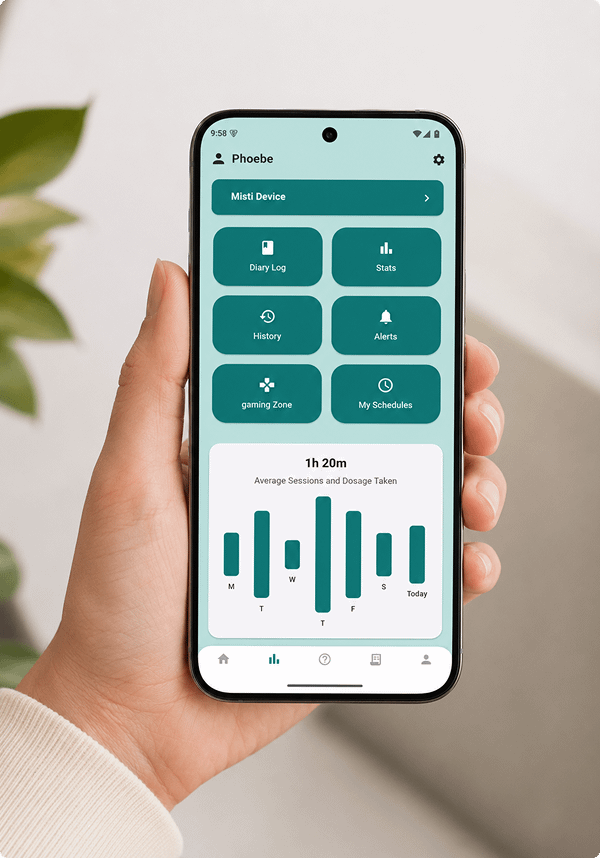
Current aerosol characterisation has shown that MedMisti™ can produce a fine aerosol profile within a range relevant to pulmonary delivery.
In standardised testing at 40 percent humidity and 25°C, Misti’s technical material reports:

A delivery system for advanced therapies must do more than aerosolise a formulation.
It must avoid damaging it.
Biologics, RNA based therapies and other complex medicines can be sensitive to heat, shear force, formulation conditions and delivery method. That makes delivery a formulation integrity challenge, not just a device challenge.
Early technical work using lipid nanoparticle mRNA constructs has shown promising results for MedMisti’s acoustic aerosol generation. Misti’s technical reports indicate that acoustic nebulisation did not cause any statistically meaningful loss of biological activity in early in vitro studies, with comparable results between untreated and acoustically nebulised LNP mRNA groups.
For pharmaceutical partners, this is an important early signal. It suggests Misti’s acoustic approach may be suitable for fragile payloads that conventional delivery systems can struggle to handle.
In respiratory care, usability is not a nice to have. If patients cannot tolerate, understand or complete treatment, the therapy
cannot perform as intended.
MedMisti™ has undergone early end user testing through a pre pilot usability study at the University of Melbourne’s Digital Simulation Lab. The study involved 15 participants, including caregivers and children aged 8 to 14 years, and combined hands on device interaction with a guided app demonstration.
The feedback also identified practical improvements around ergonomics, onboarding and in app labelling.
This matters because respiratory care depends on more than technical output. It depends on whether people can actually use the system.
Medical device translation requires more than a promising idea.
It requires scientific credibility, engineering discipline, commercialisation support, intellectual property strategy, regulatory planning and a pathway towards manufacturability.
Misti’s development has been supported by a broader research, engineering and commercialisation ecosystem.


These relationships help Misti® move beyond concept and towards practical medical device development, validation and commercial translation.
The important point is not that every milestone is complete. The important point is that Misti® is being developed with clinical, regulatory and commercial translation in view.
This is a staged evidence pathway. Each step is designed to reduce risk and move the technology closer to real world use.

MedMisti™ gives Misti® a focused application in respiratory care, where usability, timing, adherence and delivery visibility are central to treatment success.
Its role is practical: to translate the science into a usable respiratory care system.
The same delivery principles may also support future pathways across biologics, RNA based therapies, public health deployment, home based respiratory care and strategic healthcare partnerships.
Misti® is building from scientific foundation, technical development, usability evidence and a clear translation pathway.
Misti® is progressing from scientific foundation to technical validation, usability evidence
and clinical translation.
If you are exploring respiratory medicines, biologics, RNA based therapies or strategic
healthcare partnerships, this is the right time to understand the platform.
Find answers about how MedMisti™ works and what it can do for you
Misti® is supported by more than 10 years of research and development, peer reviewed work in surface acoustic wave nebulisation, early aerosol performance testing, in vitro biologic integrity work and pre pilot usability testing with caregivers and children.
Misti® is progressing through early technical and user validation. The platform is not presented as fully clinically validated on this page. The current pathway is moving towards formal external validation, regulatory readiness and clinical translation.
Current aerosol characterisation reports an MMAD of 2 to 4 micrometres, a GSD of 1.1 and a fine particle fraction greater than 90 percent under standardised testing conditions at 40 percent humidity and 25°C.
MMAD, or mass median aerodynamic diameter, helps describe aerosol particle size. Particle size matters because it influences where inhaled medicine may deposit within the respiratory system.
FPF stands for fine particle fraction. It refers to the portion of aerosol particles within a size range considered relevant for inhalation and lung deposition.
Early technical work has involved lipid nanoparticle mRNA constructs. Misti’s technical reports indicate that acoustic nebulisation did not cause any statistically meaningful loss of biological activity in early in vitro studies, with comparable results between untreated and acoustically nebulised LNP mRNA groups.
Yes. MedMisti™ underwent pre pilot usability testing at the University of Melbourne’s Digital Simulation Lab with 15 participants, including caregivers and children aged 8 to 14 years. Feedback included confidence using the device at home, good comfort and preference over spacer use.
Misti® is not only validating aerosol output. It is also focused on the delivery moment itself, including breath detection, actuation timing, device use, dose consistency and connected treatment visibility.
Further formal external validation, clinical testing, regulatory work, manufacturing readiness and expanded real world testing are still required as part of the development pathway.
Early engagement gives partners the opportunity to assess formulation fit, delivery requirements and co-development potential before the system is locked into later stage design and regulatory decisions.

